Searching for Answers (to the Wrong Problem)
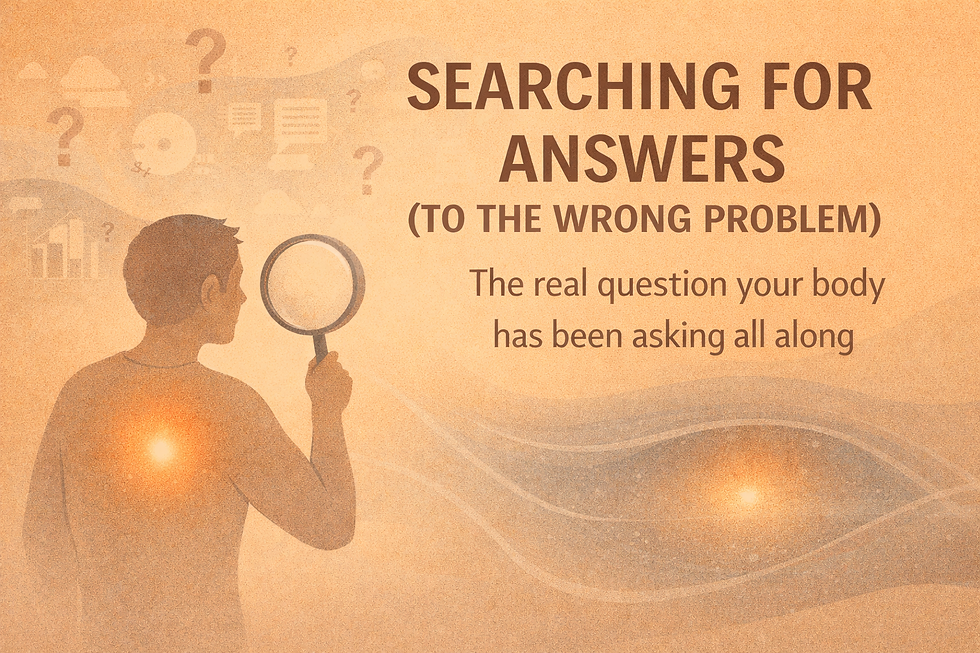
The real question your body has been asking all along
Have you ever felt like you’ve tried everything—different routines, diets, supplements, mindset shifts—and yet something still isn’t settling?
Maybe one symptom improves, but another takes its place. Or you get a few good days, only to find yourself right back where you started.
It can start to feel confusing… and honestly, exhausting.
At some point, a quieter question begins to surface:Why isn’t this working? What am I missing?
There’s a different way to look at this.
What if your body isn’t failing you—what if it’s trying, over and over again, to create a sense of safety?
The Loop That Keeps Things Going
Many persistent symptoms are part of a pattern organized around a very simple question:
“Am I safe?”
Not as a thought—but as a constant, background process in the nervous system.
When something in the body feels uncomfortable—pain, tension, uncertainty—the system can interpret it as a potential threat.
And then a loop begins:
Symptom → Urgency → Nervous System Activation → More Symptoms
It might look like this:
A sensation shows up
Your body reads it as a problem
Urgency rises: I need to fix this
Your system becomes more activated
The symptom intensifies or sticks around
And without meaning to, the loop intensifies.
Not because you’re doing anything wrong—but because your body is trying to get you to safety the only way it knows how.
When “Fixing It” Becomes the Pattern
Over time, the brain and body can become conditioned to believe:
“If I can solve this symptom, then I’ll be safe.”
That belief makes sense. It often forms gradually, through real experiences—times when discomfort, pain, or unpredictability did feel overwhelming.
But here’s where it gets complicated:
When every symptom triggers urgency, the nervous system stays in a state of alert.
And that state—subtle or intense—can influence:
muscle tension
digestion
inflammation
hormone signaling
sleep patterns
So even as you’re trying to fix the problem, your system is still asking:
“Are we safe yet?”
And the effort itself can feel like a quiet “no.”
How This Can Show Up (In Many Different Ways)
This pattern doesn’t belong to one condition or one type of person. It can show up in many forms:
Chronic pain (back, neck, shoulders):
A small flare of tension is interpreted as something that must be fixed immediately, leading to more guarding, more awareness, and often more pain.
Anxiety or panic:
The sensation of anxiety itself becomes the threat—I need this to stop—which can amplify the experience.
Migraines or headaches:
The fear of the next one can keep the body on edge, scanning for early signs, which can increase sensitivity in the system.
Digestive issues:
Bloating or discomfort becomes something to constantly monitor and control, which can keep digestion in a stressed, less regulated state.
Skin flare-ups:
Breakouts or irritation can trigger urgency and self-consciousness, reinforcing stress responses in the body.
Fatigue or burnout:
Feeling low energy becomes something to push against or override, rather than a signal to slow down, keeping the system depleted.
Hormonal symptoms:
Fluctuations are met with constant adjustment and concern, adding another layer of pressure to an already dynamic system.
Sleep struggles:
Not sleeping becomes the problem to fix, creating tension around bedtime that makes rest even harder.
Body image or weight concerns:
The body itself becomes something to correct in order to feel safe, accepted, or at ease.
In each case, the details are different. But the underlying pattern is often the same:
“When I fix this, then I can feel okay (or then I can rest, or then I will be loved, or then I can be normal.”
A Different Question to Ask
What if, instead of starting with “How do I fix this?”, you gently shifted toward answering the question your body is actually asking:
“Can I feel safe now?”
and the answer is, "Yes."
Because the truth is, safety doesn’t always come after the symptom resolves. Sometimes, it’s what allows the system to begin settling in the first place.
A Small Way to Begin
The next time something arises—a sensation, a flare, a wave of discomfort—you might try:
Pausing, just for a moment.
Notice your body. Your breath. Your surroundings.
And quietly offer:
“This is uncomfortable… but I am not in danger.”
Or,
“Something in me is reacting, but I can be present with it.”
Or,
"I see the question you are really asking, 'Am I safe?' and the answer is 'Yes, your are. You are safe.'"
You don’t have to force the feeling to go away. You’re simply giving your nervous system a different message than urgency.
Sometimes that’s where the shift begins.
This Is Not “In Your Head”
Your symptoms are real.
The pain, the discomfort, the frustration—none of that is imagined.
This isn’t about dismissing what you’re experiencing.It’s about understanding that your body may be using a learned, protective pattern to try to keep you safe.
A pattern that once made sense.A pattern that can, over time, begin to soften.
Nothing Is Broken
If you’ve been caught in this loop, it doesn’t mean you’ve done anything wrong.
It means your body has been trying—consistently, intelligently—to protect you.
But, bodies can learn.
They can learn that this moment is different than the initial circumstance that set this ball in motion. That not every sensation is a threat. That safety doesn’t have to be earned.
This isn’t a fast process. It’s not something to force or that you have to get perfect in order for it to "work".
It’s something that unfolds—in small pauses, in gentle awareness, in moments where you the message your body is receiving about how safety works begins to change.
And over time, that can change everything.
References
van der Kolk, Bessel. The Body Keeps the Score
Porges, Stephen. The Polyvagal Theory
Damasio, Antonio. The Feeling of What Happens
Pert, Candace. Molecules of Emotion
Levine, Peter. Waking the Tiger: Healing Trauma


Comments